Since 1950
Kunstpavillon
The Artist-run space in the heart of Munich
Space for contemporary art and its current production is highly contested and often only secured temporarily. All the more wonderful that the Kunstpavillon (Art Pavilion), located in the heart of the Bavarian capital Munich, within one of the city’s most urban green spaces, offers artists a place to engage with the challenges of the future.
It was artistic initiative that in 1950 transformed a war ruin into an exhibition space for the democratic new beginning in Bavaria. Today, the Kunstpavillon understands itself as an “artist-run space” that initiates artistic debates and brings new insights or aesthetic approaches in the visual arts to a broad public, also with regard to a global and intersectional discourse, yet independent of persistent clichés about high and subculture. In the exhibitions of the Kunstpavillon, the sensorial quality of art convinces.
Located in the Old Botanical Garden at Munich’s Stachus, the Kunstpavillon is a valued cultural source, a place of contemplation and reflection. For many, it marks the southern entrance to Munich’s Kunstareal with its museums, galleries, and project spaces.
History of the Kunstpavillon
Pre-War Period: Der Glaspalast (The Glass Palace) and das Haus der Deutschen Kunst (House of German Art, today Haus der Kunst)
The Münchner Glaspalast (Munich Glass Palace) in the Alter Botanischer Garten (Old Botanical Garden) at Stachus hosted significant international industrial and art exhibitions since its construction in 1854. The latter helped establish Munich’s reputation as a city of art and culture. A memorial stone on the west side of the Kunstpavillon commemorates, for example, the first long-distance direct current transmission by Oskar von Miller and Marcel Deprez, recalling the outstanding industrial exhibitions. In 1931, the Glaspalast burned down completely, destroying numerous artworks from the ongoing exhibition. Just one year later, the Bavarian Ministry of Culture announced an architectural competition for the construction of a new exhibition building of similar size. However, after the appointment of National Socialist Adolf Hitler as Reich Chancellor by Reich President Paul von Hindenburg in 1933, these plans were abandoned in favor of a fascist art policy. The architect Paul Ludwig Troost was commissioned, under the working title “Neuer Glaspalast” (New Glass Palace), to design the “Haus der Deutschen Kunst” (House of German Art) at the location favored by the Führer on the southern edge of the English Garden, inaugurated in 1937. In the eastern half of the Old Botanical Garden, a four-door small exhibition building was constructed in 1936 as a replacement for the Glaspalast to present National Socialist architectural models, along with the so-called Neptune Fountain (architect Oswald Bieber, sculptor Joseph Wackerle). The axis points south toward the central building of the Munich Palace of Justice and north toward the Higher Finance Presidency built during the Third Reich. This financial administration played a key role in the expropriation of Jewish property and the destruction of Jewish livelihoods.
Post-War Period: Protective Association of Visual Artists
After the end of the Second World War, the small exhibition building, now a roofless ruin, became a meeting point of the so-called black market. On the initiative of Hannes König, painter and founder of the independent Schutzverband Bildender Künstler (SBK) (Protective Association of Visual Artists), artists began in 1948, through collective self-help, transforming the former Nazi-era “exhibition temple” into an exhibition space for Munich’s artists. The goal was to reconnect with the great modern tradition of the Glaspalast. To finance the reconstruction, Hannes König organized art lotteries and fundraising campaigns. In return, as compensation and gratitude for the rebuilding, the association received a lease contract granting sole use of the building, which remains in effect to this day. The SBK had already been founded in Munich in 1946, one year after the liberation of the city by American forces, as part of the “Gewerkschaft der geistig und kulturell Schaffenden” (Union of Intellectual and Cultural Workers). It belonged to the Bavarian Trade Union Federation. With the founding of the German Trade Union Confederation, the SBK became a member of the nationwide union Art. Later, the SBK was actively involved in shaping the Artists’ Social Insurance Act. Today, the association, now operating as VBK (Vereinigung bildender Künstlerinnen und Künstler) (Association of Visual Artists), is part of the Visual Arts Division within the service union ver.di in the German Trade Union Confederation.
The Federal Republic: Pavilion Artists’ Group
On September 9, 1950, the bright exhibition building redesigned from the ruins was opened. One year later, as discussions around the founding of the Bundeswehr (Federal Armed Forces) were emerging, the Kunstpavillon presented a major anti-war exhibition. The “Second Exhibition Pavilion Artists’ Group” included, among others, Otto Dix and Otto Pankok. In the 1950s, at a time when carnival parades were still a fixed part of Munich’s festive season, the building and forecourt of the Kunstpavillon were transformed into workshops in which widely known satirical floats were created. This was a necessary additional source of income both for the Kunstpavillon and for the artists commissioned with the work. In the early 1960s, founding chairman Hannes König devoted himself intensively to establishing the Valentin-Karlstadt-Musäum at the Isartor. Thus, the first exhibition of the group SPUR in 1960/61 was for a long time one of the last events of supraregional significance at the Kunstpavillon. Almost all members of Gruppe SPUR had met at the Munich Academy and formed the German section of the Situationist International until their exclusion in 1962.
In Reunified Germany: From Self-Reflection to Openness
In the late 1980s, a rejuvenated board under chairman Konrad Hetz, painter and graphic artist, redefined the mission of the Kunstpavillon: fewer exhibitions restricted to members only, more space for external and international artists. An example of this new direction is the 1993 thematic exhibition “Wehret den Anfängen” (Resist the Beginnings), which reflected on the 60th anniversary of the National Socialist seizure of power together with xenophobia in reunified Germany. At the turn of the millennium, the artists forming the supporting association Kunstpavillon e.V. formulated: “We want to set a counterpoint to the established art world and, through interdisciplinary work, seek answers to current social questions.”
21st Century: artist-run space
In the 21st century, the Kunstpavillon sees itself as a non-profit artist-run space particularly committed to solidaristic forms of artistic collaboration. Since its renovation in 2015, it has had an exhibition space of around 150 square meters. These are used for approximately ten volunteer-organized exhibitions per year as well as for additional public events such as performances, concerts, and panel discussions. Upon request, the Kunstpavillon is also available to artists as a temporary studio or experimental workshop at short notice. One summer exhibition is explicitly dedicated to art collectives, collaborative working methods, or cooperative processes in the visual arts (Collaborative Works / pratiques complicitaires). The autumn exhibition serves the in-depth discussion of an outstanding artistic work. It opens before Munich’s gallery weekend Open Art in mid-September and closes only after the Long Night of Museums at the end of October. Further exhibitions, especially in spring, support academy classes and young artists or provide a platform for often controversial engagement with new developments in contemporary art and its working approaches.
In August each year, the Kunstpavillon presents selected works by the winners of the “Seerosenpreis” (Water Lily Prize). The award was established in 1962 on the initiative of the then mayor Hans-Jochen Vogel and the painter Hermann Geiseler by the City of Munich. It is awarded annually by a jury of members of Munich artists’ groups to artists who have been active for many years and whose life and creative center is in Munich. The award ceremony takes place at the Kunstpavillon and is conferred by the City of Munich (see also Seerosenkreis). Before Christmas, the Kunstpavillon hosts the traditional annual exhibition of members of the Vereinigung Bildender Künstlerinnen und Künstler Fachgruppe Bildende Kunst in der Dienstleistungsgewerkschaft ver.di (VBK). Each year, the Kunstpavillon also supports two additional VBK exhibitions, a thematic exhibition and an exhibition promoting emerging professional artists.
Kunstpavillon: A Space for Art
What distinguishes the Kunstpavillon from Kunsthallen (art halls) and galleries is not only its diversity and its eventful history. It is responsibly led by artists and organized on a voluntary basis. This also means that aesthetic debates in their social nuances and possible developments in the visual arts can become visible here at a very early stage, before art theory can fully grasp them or curators and art dealers focus and mediate them. Examples include terms from early Kunstpavillon publications such as “Prozesse aufzeigen” (demonstrating processes), “Produzenten-Pavillon” (Producers’ Pavilion), “Forum Pavillon,” “zeitkritische Auseinandersetzung” (critical engagement with the present), and “Kunst auf andere Art vermitteln” (communicating art in a different way). Ideas that were entirely of their time, yet the Kunstpavillon pioneered such concepts and formats before they later became standard practice, sometimes to the point of no longer being noticed. In this logic, the artists reinvent their Kunstpavillon in the Old Botanical Garden at Stachus again and again. A space for art, also for its consumption and its critique, and always with the sustainable aspiration: to continue drawing the line of culture. Unusual. Free.
Maxvorstadt: Sophienstraße 7a, 80333 Munich
Founder: Hannes König
Current Director: Lena Bröcker, Rita Hensen, Katharina Weishäupl
Short description: The Kunstpavillon is a volunteer-run artist-run space that provides space for contemporary art and current artistic debates.
Type of space: Artist-run space
The Artist-run space in the heart of Munich
Space for contemporary art and its current production is highly contested and often only secured temporarily. All the more wonderful that the Kunstpavillon (Art Pavilion), located in the heart of the Bavarian capital Munich, within one of the city’s most urban green spaces, offers artists a place to engage with the challenges of the future.
It was artistic initiative that in 1950 transformed a war ruin into an exhibition space for the democratic new beginning in Bavaria. Today, the Kunstpavillon understands itself as an “artist-run space” that initiates artistic debates and brings new insights or aesthetic approaches in the visual arts to a broad public, also with regard to a global and intersectional discourse, yet independent of persistent clichés about high and subculture. In the exhibitions of the Kunstpavillon, the sensorial quality of art convinces.
Located in the Old Botanical Garden at Munich’s Stachus, the Kunstpavillon is a valued cultural source, a place of contemplation and reflection. For many, it marks the southern entrance to Munich’s Kunstareal with its museums, galleries, and project spaces.
History of the Kunstpavillon
Pre-War Period: Der Glaspalast (The Glass Palace) and das Haus der Deutschen Kunst (House of German Art, today Haus der Kunst)
The Münchner Glaspalast (Munich Glass Palace) in the Alter Botanischer Garten (Old Botanical Garden) at Stachus hosted significant international industrial and art exhibitions since its construction in 1854. The latter helped establish Munich’s reputation as a city of art and culture. A memorial stone on the west side of the Kunstpavillon commemorates, for example, the first long-distance direct current transmission by Oskar von Miller and Marcel Deprez, recalling the outstanding industrial exhibitions. In 1931, the Glaspalast burned down completely, destroying numerous artworks from the ongoing exhibition. Just one year later, the Bavarian Ministry of Culture announced an architectural competition for the construction of a new exhibition building of similar size. However, after the appointment of National Socialist Adolf Hitler as Reich Chancellor by Reich President Paul von Hindenburg in 1933, these plans were abandoned in favor of a fascist art policy. The architect Paul Ludwig Troost was commissioned, under the working title “Neuer Glaspalast” (New Glass Palace), to design the “Haus der Deutschen Kunst” (House of German Art) at the location favored by the Führer on the southern edge of the English Garden, inaugurated in 1937. In the eastern half of the Old Botanical Garden, a four-door small exhibition building was constructed in 1936 as a replacement for the Glaspalast to present National Socialist architectural models, along with the so-called Neptune Fountain (architect Oswald Bieber, sculptor Joseph Wackerle). The axis points south toward the central building of the Munich Palace of Justice and north toward the Higher Finance Presidency built during the Third Reich. This financial administration played a key role in the expropriation of Jewish property and the destruction of Jewish livelihoods.
Post-War Period: Protective Association of Visual Artists
After the end of the Second World War, the small exhibition building, now a roofless ruin, became a meeting point of the so-called black market. On the initiative of Hannes König, painter and founder of the independent Schutzverband Bildender Künstler (SBK) (Protective Association of Visual Artists), artists began in 1948, through collective self-help, transforming the former Nazi-era “exhibition temple” into an exhibition space for Munich’s artists. The goal was to reconnect with the great modern tradition of the Glaspalast. To finance the reconstruction, Hannes König organized art lotteries and fundraising campaigns. In return, as compensation and gratitude for the rebuilding, the association received a lease contract granting sole use of the building, which remains in effect to this day. The SBK had already been founded in Munich in 1946, one year after the liberation of the city by American forces, as part of the “Gewerkschaft der geistig und kulturell Schaffenden” (Union of Intellectual and Cultural Workers). It belonged to the Bavarian Trade Union Federation. With the founding of the German Trade Union Confederation, the SBK became a member of the nationwide union Art. Later, the SBK was actively involved in shaping the Artists’ Social Insurance Act. Today, the association, now operating as VBK (Vereinigung bildender Künstlerinnen und Künstler) (Association of Visual Artists), is part of the Visual Arts Division within the service union ver.di in the German Trade Union Confederation.
The Federal Republic: Pavilion Artists’ Group
On September 9, 1950, the bright exhibition building redesigned from the ruins was opened. One year later, as discussions around the founding of the Bundeswehr (Federal Armed Forces) were emerging, the Kunstpavillon presented a major anti-war exhibition. The “Second Exhibition Pavilion Artists’ Group” included, among others, Otto Dix and Otto Pankok. In the 1950s, at a time when carnival parades were still a fixed part of Munich’s festive season, the building and forecourt of the Kunstpavillon were transformed into workshops in which widely known satirical floats were created. This was a necessary additional source of income both for the Kunstpavillon and for the artists commissioned with the work. In the early 1960s, founding chairman Hannes König devoted himself intensively to establishing the Valentin-Karlstadt-Musäum at the Isartor. Thus, the first exhibition of the group SPUR in 1960/61 was for a long time one of the last events of supraregional significance at the Kunstpavillon. Almost all members of Gruppe SPUR had met at the Munich Academy and formed the German section of the Situationist International until their exclusion in 1962.
In Reunified Germany: From Self-Reflection to Openness
In the late 1980s, a rejuvenated board under chairman Konrad Hetz, painter and graphic artist, redefined the mission of the Kunstpavillon: fewer exhibitions restricted to members only, more space for external and international artists. An example of this new direction is the 1993 thematic exhibition “Wehret den Anfängen” (Resist the Beginnings), which reflected on the 60th anniversary of the National Socialist seizure of power together with xenophobia in reunified Germany. At the turn of the millennium, the artists forming the supporting association Kunstpavillon e.V. formulated: “We want to set a counterpoint to the established art world and, through interdisciplinary work, seek answers to current social questions.”
21st Century: artist-run space
In the 21st century, the Kunstpavillon sees itself as a non-profit artist-run space particularly committed to solidaristic forms of artistic collaboration. Since its renovation in 2015, it has had an exhibition space of around 150 square meters. These are used for approximately ten volunteer-organized exhibitions per year as well as for additional public events such as performances, concerts, and panel discussions. Upon request, the Kunstpavillon is also available to artists as a temporary studio or experimental workshop at short notice. One summer exhibition is explicitly dedicated to art collectives, collaborative working methods, or cooperative processes in the visual arts (Collaborative Works / pratiques complicitaires). The autumn exhibition serves the in-depth discussion of an outstanding artistic work. It opens before Munich’s gallery weekend Open Art in mid-September and closes only after the Long Night of Museums at the end of October. Further exhibitions, especially in spring, support academy classes and young artists or provide a platform for often controversial engagement with new developments in contemporary art and its working approaches.
In August each year, the Kunstpavillon presents selected works by the winners of the “Seerosenpreis” (Water Lily Prize). The award was established in 1962 on the initiative of the then mayor Hans-Jochen Vogel and the painter Hermann Geiseler by the City of Munich. It is awarded annually by a jury of members of Munich artists’ groups to artists who have been active for many years and whose life and creative center is in Munich. The award ceremony takes place at the Kunstpavillon and is conferred by the City of Munich (see also Seerosenkreis). Before Christmas, the Kunstpavillon hosts the traditional annual exhibition of members of the Vereinigung Bildender Künstlerinnen und Künstler Fachgruppe Bildende Kunst in der Dienstleistungsgewerkschaft ver.di (VBK). Each year, the Kunstpavillon also supports two additional VBK exhibitions, a thematic exhibition and an exhibition promoting emerging professional artists.
Kunstpavillon: A Space for Art
What distinguishes the Kunstpavillon from Kunsthallen (art halls) and galleries is not only its diversity and its eventful history. It is responsibly led by artists and organized on a voluntary basis. This also means that aesthetic debates in their social nuances and possible developments in the visual arts can become visible here at a very early stage, before art theory can fully grasp them or curators and art dealers focus and mediate them. Examples include terms from early Kunstpavillon publications such as “Prozesse aufzeigen” (demonstrating processes), “Produzenten-Pavillon” (Producers’ Pavilion), “Forum Pavillon,” “zeitkritische Auseinandersetzung” (critical engagement with the present), and “Kunst auf andere Art vermitteln” (communicating art in a different way). Ideas that were entirely of their time, yet the Kunstpavillon pioneered such concepts and formats before they later became standard practice, sometimes to the point of no longer being noticed. In this logic, the artists reinvent their Kunstpavillon in the Old Botanical Garden at Stachus again and again. A space for art, also for its consumption and its critique, and always with the sustainable aspiration: to continue drawing the line of culture. Unusual. Free.
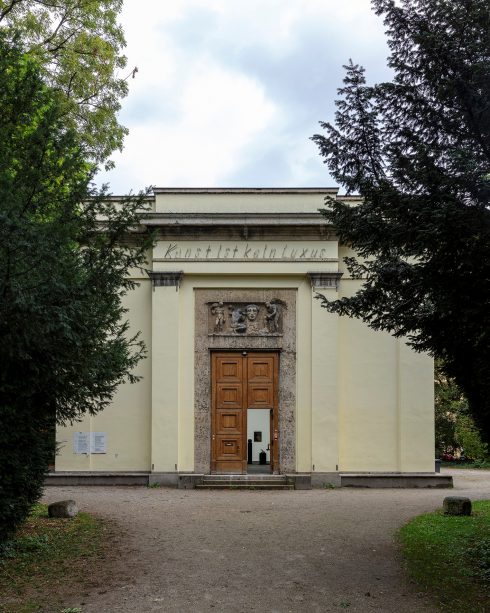
Exterior view, Kunstpavillon, photo: © Sebastian Kissel (low res)